Communication from humanity’s earliest sounds and images through writing, broadcasting, digital media, and communication across outer space. It treats audio and visual communication as interconnected forces that preserve memory, overcome distance, and extend human presence beyond Earth.
From the First Voice to the Shores of Space: The Evolution of Audio and Visual Communication
Communication began long before alphabets, telephones, screens, or satellites. It began when one living being attempted to influence the awareness of another. A cry warned of danger. A gesture directed attention. A rhythm encouraged people to move together. A picture preserved something that could no longer be seen. From these simple beginnings developed two of humanity’s most powerful channels of expression: sound and vision.
The history of communication is therefore more than a history of machines. It is the story of humanity’s continuing effort to overcome fundamental barriers: silence, distance, time, isolation, and eventually the enormous emptiness of outer space.
The First Language of Sound
The earliest forms of human audio communication were probably inseparable from immediate survival. Calls, cries, changes in vocal tone, clapping, and rhythmic sounds could warn a group, express fear, summon help, identify a person, or coordinate collective movement. Over time, repeated sounds became recognisable patterns. These patterns gradually developed into spoken language.
The beginnings of speech are difficult to date precisely, but accounts of communication history commonly place its emergence deep in prehistory. Oral communication later developed into storytelling, chants, poems, songs, and ceremonies through which communities transmitted knowledge and identity. [en.wikipedia.org]
The human voice became the first great communication instrument because it could carry more than literal information. Volume suggested urgency. Pitch conveyed emotion. Rhythm assisted memory. Silence could communicate hesitation, respect, grief, or expectation.
Before writing, memory lived within people. Elders, storytellers, singers, and knowledge holders acted as living archives. A story had to survive by being heard, remembered, and spoken again. Repetition, rhyme, melody, and performance were not merely artistic decorations. They were technologies of memory.
Audio communication also extended beyond the individual voice. Drums, horns, bells, whistles, and other instruments could carry signals farther than ordinary speech. A community could announce danger, ceremony, arrival, victory, mourning, or assembly through distinctive sounds. In this way, sound began to conquer physical distance.
The First Visual Messages
Alongside sound, early humans communicated through the body and the visible environment. Facial expressions, hand movements, posture, eye direction, and physical demonstrations allowed meaning to be shared without speech.
Visual communication gained permanence when people began placing symbols and images on rock, bone, wood, and other surfaces. Cave paintings, petroglyphs, pictograms, and symbolic markings allowed an experience to remain visible after its creator had departed. Some of the earliest known communicative symbols and cave paintings date to tens of thousands of years ago. [en.wikipedia.org]
A painted animal might represent food, danger, spiritual meaning, ancestral memory, or knowledge about the surrounding landscape. A sequence of marks might record movement, seasons, ownership, or repeated events. Although the precise meanings of many ancient images remain uncertain, their existence demonstrates a profound intellectual step: an idea could be separated from the immediate moment and stored outside the human mind.
This was one of communication’s greatest transformations. The voice disappeared after it was spoken, but an image remained. Visual expression gave humanity a form of external memory.
Writing and the Preservation of Thought
The gradual development of writing changed communication from a primarily living exchange into a durable record. Pictures and symbols became increasingly organised, and writing systems allowed information to be preserved with greater precision.
Writing made it possible to record agreements, laws, religious teachings, observations, trade, history, ownership, and personal thought. A message no longer required the speaker and listener to occupy the same place or even the same lifetime.
Yet writing also changed authority. Spoken knowledge could be flexible and communal, while written knowledge could be copied, controlled, stored, interpreted, and enforced. Those who could read, write, or control written records possessed considerable influence.
The development of alphabets made written language more adaptable by representing speech through a manageable collection of signs. Manuscripts carried ideas across generations, but their production remained slow because texts had to be copied by hand.
Printing eventually increased the scale and speed of reproduction. Once many identical copies could be produced, communication moved toward mass distribution. Books, newspapers, pamphlets, posters, diagrams, and maps allowed ideas to reach audiences far beyond the original author’s presence.
The visual message had become reproducible.
Sound Becomes Recordable
For most of human history, spoken words vanished once their sound faded. The development of sound recording fundamentally altered this condition. Voices, music, speeches, and environmental sounds could now be captured and replayed.
Recorded sound separated the voice from both the body and the moment of performance. A person could hear someone who was far away or no longer alive. Accents, songs, oral histories, and public speeches could become part of a lasting audio record.
The telephone introduced a different breakthrough by allowing voices to travel between distant locations in near real time. Radio expanded this principle from one-to-one conversation to one-to-many broadcasting. A single speaker or performance could enter homes across a vast region.
Radio created a shared audio environment. News, drama, music, sport, education, advertising, and emergency information could all be distributed to dispersed audiences. People separated by geography could listen to the same event and feel connected to a common moment.
Photography, Film, and Television
Photography enabled light, place, and appearance to be preserved with unprecedented detail. It became a tool of memory, science, journalism, identification, art, and persuasion. A photograph appeared to offer direct evidence, even though framing, timing, selection, and context continued to influence its meaning.
Moving pictures then added time to recorded vision. Film did not simply show what something looked like. It could show movement, sequence, expression, cause, and consequence.
Editing gave visual communication a new grammar. A close-up could reveal emotion. A wide shot could establish scale. A change of angle could alter sympathy or suspicion. A sequence could compress years into minutes or prolong a moment of tension. Film could represent history, imagination, testimony, propaganda, fantasy, and dreams.
Television brought moving images and recorded sound into everyday domestic life. It combined the authority of the visible image with the emotional immediacy of the human voice. Public events could become shared visual experiences, and personalities could speak to enormous audiences through the apparent intimacy of the screen.
Audio and visual communication were no longer separate streams. They had become synchronised.
The Digital Convergence
The digital age brought writing, photography, recorded sound, film, telephony, publishing, and broadcasting into a common technological system. A single device could become a camera, microphone, editing studio, library, map, printing press, cinema, radio, and global transmitter.
The internet turned communication into a networked exchange. Traditional broadcasting generally moved from a limited number of producers toward large audiences. Digital networks allowed individuals to become both receivers and publishers.
Modern communication can now move through text messages, recorded speech, livestreams, video calls, interactive maps, animation, virtual spaces, emojis, data visualisations, and machine-generated media. A person may begin with written words, add an image, respond with a voice recording, and continue through live video.
This convergence has increased participation, but it has also created new difficulties. An image can be altered. A voice can be imitated. A video may appear authentic while presenting a constructed event. Information can travel globally before its accuracy is examined.
The greater the speed and realism of communication become, the more important verification, context, consent, and media literacy become.
Communication Leaves the Earth
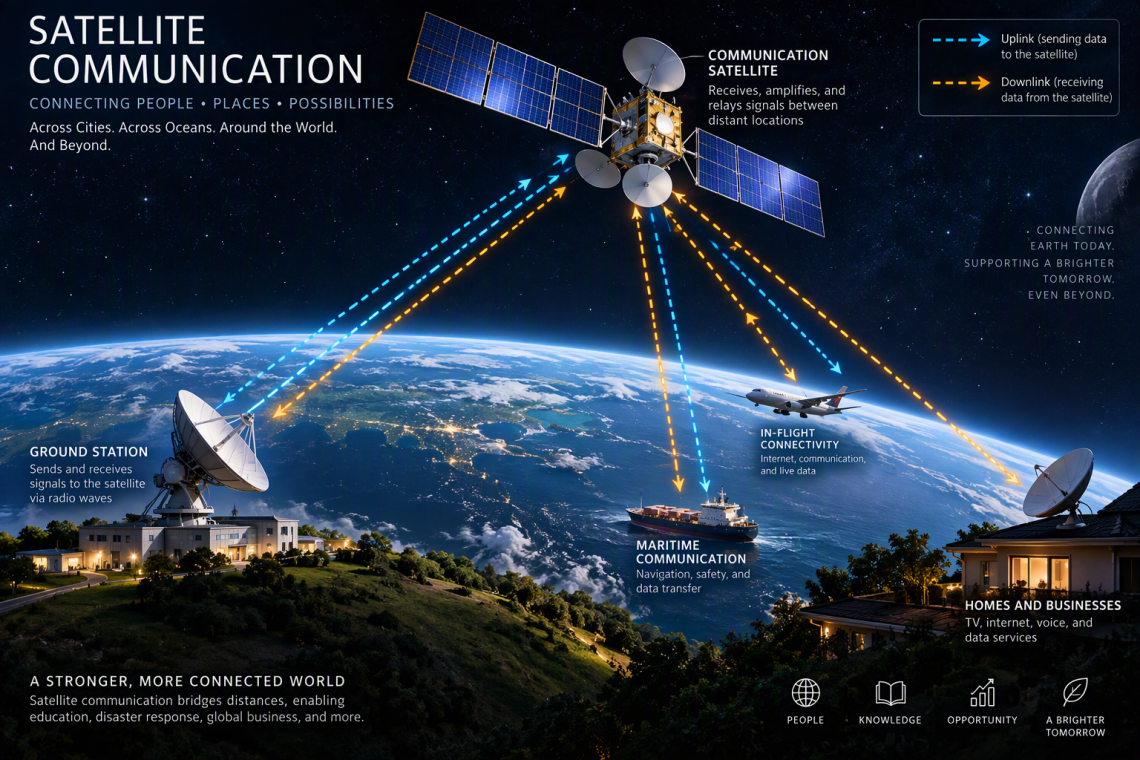
The arrival of the Space Age extended humanity’s communication problem beyond oceans and continents. Spacecraft had to receive instructions, report their condition, transmit scientific measurements, and return images across distances that made ordinary terrestrial communication systems inadequate.
Since the beginning of spaceflight, missions operated by NASA have relied heavily on radio-frequency communication to exchange data with spacecraft. Radio allowed humanity to maintain an invisible connection with machines travelling far beyond the atmosphere. [nasa.gov]
Space communication transformed distant worlds from points of light into observed landscapes. Robotic spacecraft could act as extensions of human sight and hearing, detecting signals and converting measurements into images, audio representations, and scientific data.
However, communication across space is constrained by physics. Signals travel at the speed of light, but they do not arrive instantaneously across astronomical distances. As missions travel farther from Earth, communication delays increase. A future crew far from Earth could not always depend on immediate instructions or natural conversation with people at home.
This means that space communication must be designed not only for distance but also for delay, reliability, autonomy, and limited opportunities for transmission.
From Radio Waves to Laser Light
Modern spacecraft and scientific instruments are capable of collecting immense quantities of information. Traditional radio remains essential, but the growing volume of mission data has encouraged the development of optical communication.
NASA describes optical communication as the transmission of information through laser light rather than radio frequency. The technology is being developed to address limitations involving bandwidth, equipment size, spectrum use, and power. [nasa.gov]
Both radio and infrared signals travel at the speed of light, but infrared communication can carry more data within a link because of its higher frequency. Laser systems can also be lighter and require less power than comparable radio systems, although clouds and atmospheric turbulence can interfere with their signals. [nasa.gov]
Rather than simply replacing radio, optical systems may complement it. Radio can offer resilience and established coverage, while tightly directed laser links can provide high-capacity transmission. NASA has described a future in which enhanced radio, optical communication, high-speed networking, and other technologies work together to support exploration over greater distances. [ntrs.nasa.gov]
This development represents a remarkable return to one of humanity’s earliest communication methods: light used as a signal. The difference is scale. What may once have been a fire on a hill or a flashing reflection is becoming a precisely modulated beam crossing millions of kilometres.
Audio and Video Beyond Modern Time
As humans establish longer-term activity around the Moon, travel toward Mars, and send robotic explorers deeper into the Solar System, audio and video will become more than ways of reporting a mission. They will help sustain identity, morale, education, medical support, scientific cooperation, and relationships with Earth.
A video message from Mars would not function exactly like a live conversation. Because of transmission delay, communication would become partly asynchronous. People would record complete thoughts, experiences, instructions, or emotional messages and then wait for a response.
This could produce an unexpected combination of old and new communication. Future space travellers may possess advanced cameras, immersive displays, and laser transmitters, yet their messages may resemble ancient letters or oral histories: carefully prepared accounts sent across a great silence.
Communication between planets will also require cultural adaptation. On Earth, people often expect immediate replies. Across space, delay will be unavoidable. Patience, clarity, context, and emotional completeness may therefore become essential features of interplanetary communication.
Future visual systems may allow people to experience remote environments through three-dimensional imaging, virtual reality, robotic telepresence, or detailed scientific reconstruction. Audio systems could recreate spatial sound, isolate voices in noisy habitats, translate languages, or convert scientific measurements into audible patterns.
Artificial intelligence may assist by compressing data, identifying important observations, translating messages, organising archives, and helping distant crews make decisions. Yet the meaning and ethical responsibility of communication will remain human concerns. Technology can carry a message, but it cannot automatically guarantee truth, wisdom, or understanding.
Messages for Unknown Listeners
The furthest horizon of communication is the possibility of contact with intelligence beyond humanity. Such communication would be profoundly difficult because the sender and receiver might share no language, culture, biology, senses, or understanding of intention.
A message intended for an unknown intelligence might therefore begin with detectable patterns: repetition, mathematics, physical constants, diagrams, or structured sequences. Even then, recognition would not guarantee interpretation.
The problem reveals something fundamental about all communication. Sending a signal is not the same as being understood. Communication succeeds only when meaning can be constructed between minds.
Any attempt to communicate beyond the human world would also force difficult questions. Who speaks for Earth? What should be said about humanity? Should a message emphasise science, culture, biology, peace, caution, or simple existence? Would audio and visual forms be meaningful to a being that experiences reality through entirely different senses?
These questions cannot be solved by transmission power alone. They require philosophy, science, ethics, and international cooperation.
Conclusion: The Unbroken Human Signal
The journey from the first cry to interplanetary laser communication is not a story in which one medium simply replaces another. Speech did not disappear when writing emerged. Images did not eliminate sound. Radio survived television. Print continues beside digital media. Each new form has joined, transformed, or extended the forms that came before it.
The essential purpose has remained remarkably constant. Communication allows one consciousness to reach toward another. It carries warning, memory, knowledge, emotion, identity, imagination, and hope.
The first people who marked a cave wall were sending meaning beyond the immediate moment. The first storytellers were carrying memory beyond a single lifetime. Radio sent the human voice beyond the visible horizon. Film preserved movement. Digital networks joined distant communities. Space communication now sends human knowledge beyond Earth.
In the future, our messages may cross the Solar System through radio waves and laser light. They may be received by astronauts, autonomous machines, distant descendants, or perhaps an intelligence we cannot yet imagine. Whatever form those messages take, they will continue an ancient declaration expressed through every human voice, picture, symbol, and signal:
We are here. We have seen. We have remembered. We are reaching out.

