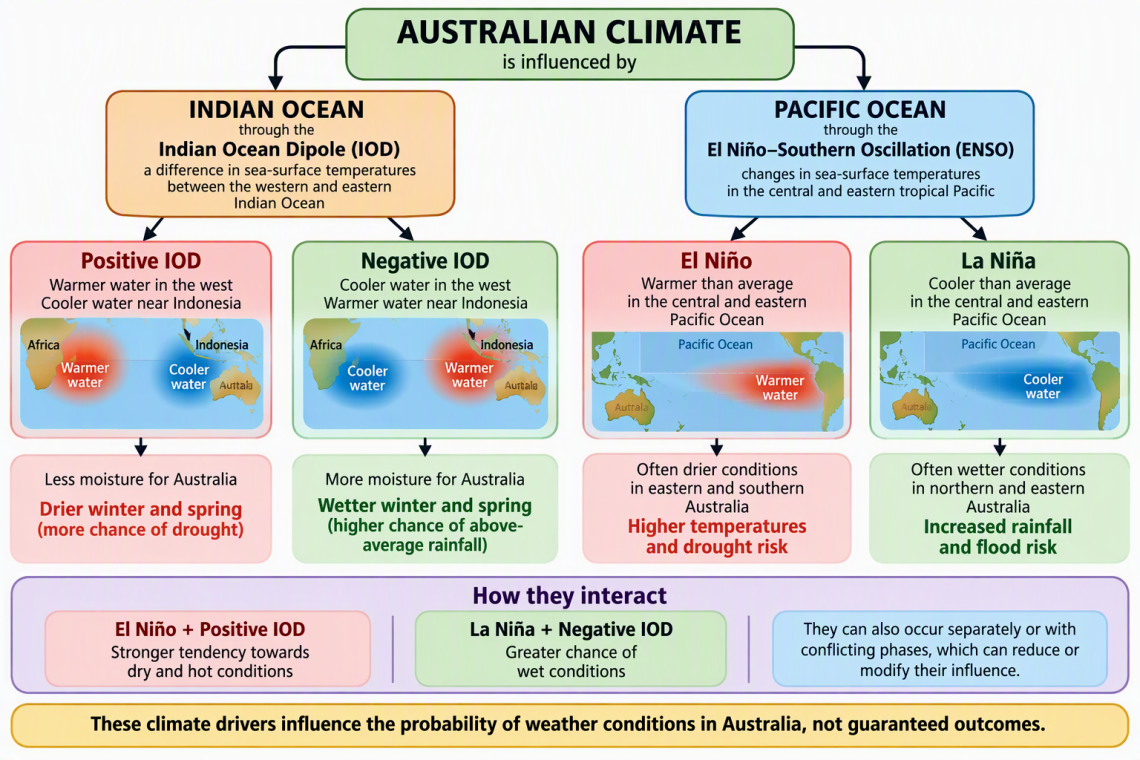
Here’s a clear comparison of the three major ocean–atmosphere patterns that influence Australian climate.
Quick comparison
| Climate driver | Ocean | Phase or system | Typical influence on Australia |
|---|---|---|---|
| Indian Ocean Dipole, IOD | Indian Ocean | Positive, neutral or negative | Influences winter and spring rainfall, especially across southern and eastern Australia |
| El Niño | Tropical Pacific Ocean | Warm phase of ENSO | Often drier and warmer across eastern and southern Australia |
| La Niña | Tropical Pacific Ocean | Cool phase of ENSO | Often wetter across northern and eastern Australia |
Indian Ocean Dipole, IOD
The Indian Ocean Dipole measures the difference in sea-surface temperatures between the western tropical Indian Ocean, near Africa, and the eastern tropical Indian Ocean, near Indonesia. [bom.gov.au]
- Positive IOD: The western Indian Ocean is relatively warmer and the eastern region near Indonesia is relatively cooler. This commonly reduces moisture available to Australia, increasing the likelihood of drier conditions across southern and eastern areas.
- Negative IOD: Waters near Indonesia are relatively warmer, providing more moisture for weather systems crossing Australia and increasing the likelihood of above-average rainfall.
- Neutral IOD: There is no strong temperature difference driving an established positive or negative pattern.
IOD events usually develop around May or June, peak between August and October, and rapidly weaken around the end of spring or beginning of summer as the northern monsoon develops. [bom.gov.au]
El Niño
El Niño is the warm phase of the El Niño–Southern Oscillation, or ENSO. During El Niño, sea-surface temperatures in the central and eastern tropical Pacific become warmer than average. [bom.gov.au], [bom.gov.au]
For Australia, El Niño has often coincided with:
- Reduced winter and spring rainfall, particularly in the eastern half of the country
- Higher daytime temperatures in southern areas
- Increased frost risk because of clearer skies
- A greater likelihood of dry conditions, although individual events vary [bom.gov.au]
La Niña
La Niña is the cool phase of ENSO. During La Niña, sea-surface temperatures in the central and eastern tropical Pacific become cooler than average. [bom.gov.au], [bom.gov.au]
La Niña typically increases the likelihood of wetter conditions across northern and eastern Australia. It can persist longer than El Niño, with about half of La Niña events lasting two or three years. [bom.gov.au]
How they interact
These climate drivers can occur together:
- El Niño + positive IOD: Their drying influences can reinforce one another.
- La Niña + negative IOD: There is generally a greater chance of above-average winter and spring rainfall.
- Conflicting phases: One driver may reduce or modify the influence of another. [bom.gov.au]
The simplest memory aid is:
Pacific Ocean: El Niño tends dry, La Niña tends wet.
Indian Ocean: Positive IOD tends dry, negative IOD tends wet.
These are shifts in probability, not guarantees. The Bureau notes that ENSO and the IOD are only parts of a complex climate system, so long-range forecasts remain the best guide to expected seasonal conditions. [bom.gov.au], [bom.gov.au]
Read the Bureau’s Indian Ocean Dipole guide and El Niño and La Niña guide.

